The Row N/S Park Tote Buying Guide: Small vs Medium vs Large
At roughly the third time you pick one up, something shifts: the N/S Park Tote stops looking plain and starts reading as inevitable. Nothing about the bag performs: no plaque, no monogram, no contrast stitching begging to be photographed. Instead you get a vertical proportion that works unaided plus handles positioned to keep the bag flat against your side. That is the whole pitch, and it has been enough to make this the least noisy success in the catalogue and, on the numbers below, the most durable resale performer the brand has made. The difficulty is not deciding whether to buy one. The hard part is choosing between Small, Medium and Large, because all three convince in isolation and only reveal their differences once you have loaded them. The sections below walk through those differences alongside the prices observed in the market in 2026, which should be read as market observations rather than an official price list.
What Changes When a Tote Is N/S
The N/S in the name means north-south, so the bag is taller than it is wide, and that single decision about orientation dictates everything that follows. A vertical tote keeps its contents stacked rather than spread, so items stay easy to find instead of disappearing into corners. It also sits closer to the body, which matters more than it sounds when you are threading through a crowded street or a train carriage. The trade-off is that anything genuinely wide, such as a large laptop turned sideways, fights the shape rather than settling into it. The brand deploys this shorthand across several families and treats orientation as a specification rather than a styling note, which suits a house that names its bags by measurement instead of by mood. Coming from horizontal totes, the first week with a vertical one reads as relearning a habit, and by the end of it as an upgrade.
The Small: A Minimum yves st laurent Viable Bag
People misjudge the Small in photographs, then buy it regardless. The brief is the daily minimum rather than the laptop: phone, wallet, keys, sunglasses and a paperback, not a working day’s worth of equipment. Vertical proportions let it hold more than a horizontal tote with the same footprint, and it holds its line when half full. Of the three it reads most plainly as a purposeful object rather than a container, and in pictures it registers as a shape rather than a bag full of things. There is a real compromise here, since the size will not survive overfilling without the line going, and overfilling any soft-sided tote is the quickest way to ruin one. Observed 2026 pricing puts the Small at $1,550 to $1,620, the cheapest available route into the silhouette.
The Medium: The One Most People Should Buy
The Medium is the default recommendation, and it earns that place by being the only size that does not force a trade. It swallows a full day of belongings and holds its structure, the single quality that counts most in a bag with no rigid frame behind it. The vertical proportion pays off most obviously here, as the added height opens depth for a bottle, a folder or a small camera while adding no width against your body. It stays put on the shoulder and clears the ground in the hand. It is easily the most versatile row bag in the entry-to-middle price band, and it is the one that lives in use rather than in the dust bag. Observed 2026 pricing places the Medium between $1,650 and $1,950, depending on material and finishing.
The Large: All the Capacity, With a Caveat
Rather than a scaled-up accessory, the Large is a true work and travel bag, and it deserves to be bought for that job specifically. It takes a laptop, a notebook, a change of shoes and the miscellaneous debris of a commute, all without the slab-sided stiffness that makes hard-sided work totes unpleasant to carry. The caveat comes down to physics, since the bigger a soft tote gets the more it needs you not to overload it, and a Large filled to capacity leans rather than standing. This is also where the price range opens up dramatically, running from $1,990 to $3,250 in observed 2026 pricing, a larger spread than the Small and Medium combined. Anyone treating this as their only The Row tote bag will get considerably more use out of it than out of either smaller size. Anyone adding it as a second bag next to a Medium will find it sits unused more than they bargained for.
Size by Size: Prices Observed in 2026
The sizes ladder cleanly enough, but the gaps between them are tighter than the gaps inside them. Most size comparisons overlook that detail, since the gap between the cheapest and dearest Medium is bigger than the gap between the cheapest Medium and the cheapest Large. Read the table as a guide of where each size begins and ends, since these are prices observed in 2026 and the brand publishes no master list. The Small’s narrow band tells you it is offered in fewer versions. The Large’s broad band tells you exactly the reverse. Every one of the three sits in the middle price tier of the collection, comfortably below the Margaux family and comfortably above the pouches and wallets.
| Size option | Price observed in 2026 | Suits |
|---|---|---|
| Small | $1,550 to $1,620 | Essentials only, evenings, the silhouette at its tidiest |
| Medium | $1,650 to $1,950 | Daily carry, the default pick for most buyers |
| Large | $1,990 to $3,250 | Work, laptops, travel, deliberate overcapacity |
Why the Range Inside One Size Is So Wide
Inside one size the spread tracks material and finish, not capacity, and that is worth grasping before you assume a more expensive Large is a bigger Large. Exterior materials across the collection run from smooth, matte grained, saddle and polished calfskin through suede, canvas, nylon and woven sisal, each at a different price. Suede consistently costs more than calfskin on an identical silhouette elsewhere in the line, and stitched or edge-finished treatments add cost again. Linings follow the same logic, since the house uses nappa, lambskin, calfskin and cotton herringbone rather than a printed logo jacquard, and those are materials with real cost attached. Hardware is palladium-plated and finished matte or brushed right across the collection, so it is not the source of the variation. The practical point is that you are choosing a material at a given size rather than buying a better version of the same bag.
How It Sits Within the Wider Park Family
The N/S Park Tote is one member of a wider family, and knowing its neighbours stops an expensive mistake. The Park Tote itself comes in Small and Medium at $1,450 to $1,620 in observed 2026 pricing, which puts it a little below the N/S on price. The Park Tote Three, including its edge, stitch and canvas executions, runs $1,750 to $2,400 and suits anyone who likes the family but wants a noticeably different construction. Sitting above them, the XL Park Tote is $2,490, while a stitched XL has been observed at $4,570, and that jump comes from handwork rather than size. Below the entire group the N/S Park Crossbody sits at $1,290, the least expensive entry into the shape language and a genuinely useful bag in its own right. Between them these five cover almost every use case, which is why so many owners of one The Row bag end up owning two.
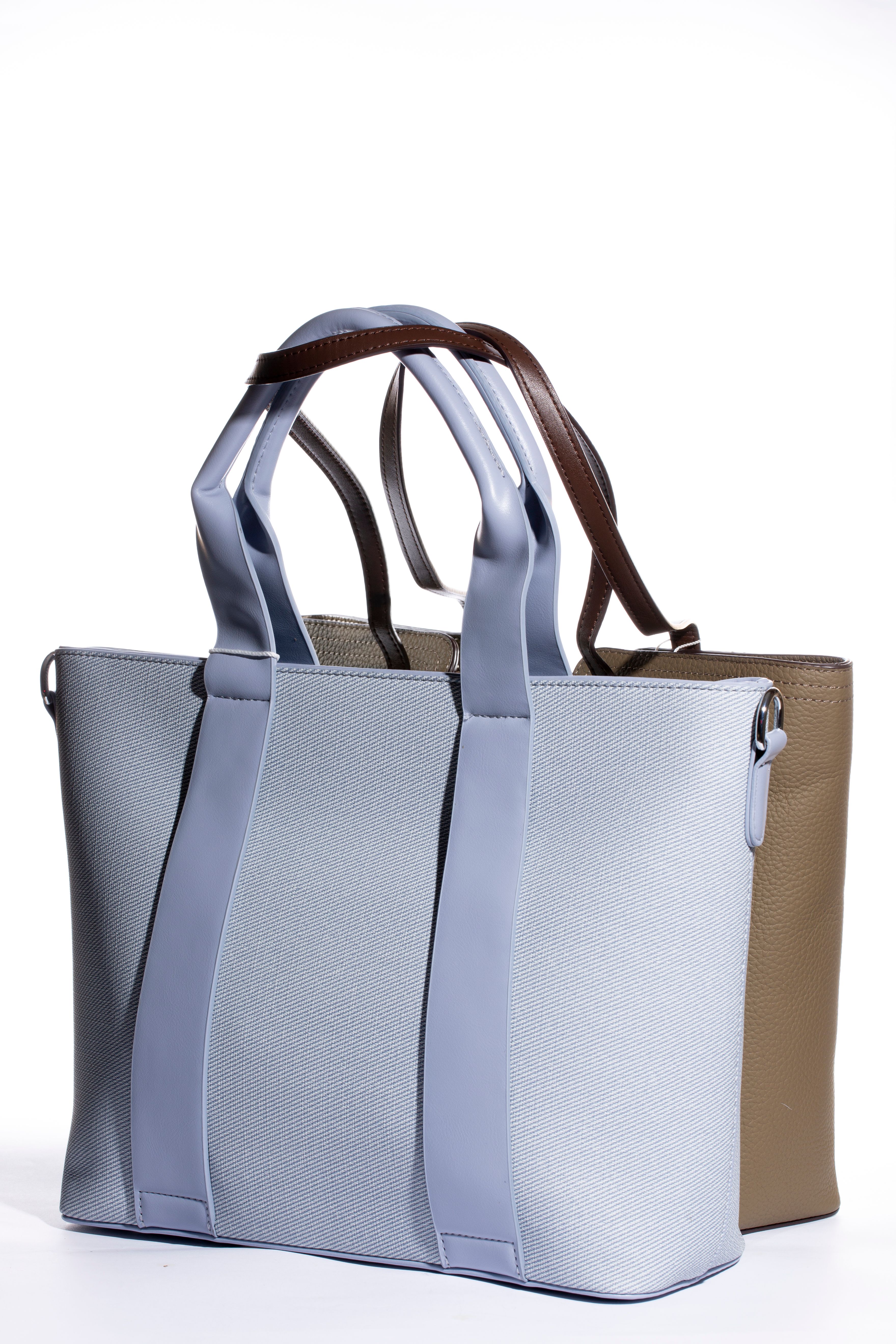
Resale Value, Care and the Verdict
Beyond being a good bag, the N/S Park Tote is the strongest resale performer the brand has recorded. In the Rebag CLAIR 2025 report it posted 146 percent value retention, the best of any model listed for the label, against a brand-level figure of 97 percent that carried The Row into the report’s unicorn tier for the first time. Read that as observed market behaviour rather than investment advice, with one qualification attached: canvas, nylon, sisal and seasonal-colour pieces routinely discount, and the strength sits in black and neutral leather. Care follows the material rather than any brand-issued protocol, so buff calfskin with a soft dry cloth, brush suede and keep it out of the wet, and spot-clean woven versions only. Avoid overfilling any of the three sizes, and keep the bag lightly stuffed in its dust bag so the shape holds. Take the Small if you carry little, the Large if you commute with a laptop, and the Medium if you cannot decide, because the Medium is the one you will actually use.
- Small at $1,550 to $1,620: the silhouette at its most sculptural
- Medium at $1,650 to $1,950: the everyday choice for most buyers
- Large at $1,990 to $3,250: working days, travel and the widest choice of materials
Leave a Reply